
Art Without a Body: on AI and Art

Updated: May 13
There is a strange absence at the center of AI-generated art. The image is there. The composition holds. Sometimes, it is even beautiful. But something does not arrive with it.
It has no body.
Not in the literal sense… pixels can render skin, light, gesture… but in the way a work carries the weight of having been lived through. Traditional art has always been tethered to a body, even when that body is distant or obscured. A painting carries the trace of the hand that made it. A poem carries the rhythm of breath. A film carries the accumulated decisions of people negotiating meaning in real time.
AI art interrupts that chain. It produces form without ever having inhabited the conditions that give form its urgency. It offers a completed surface: one that can resemble expression without passing through experience.
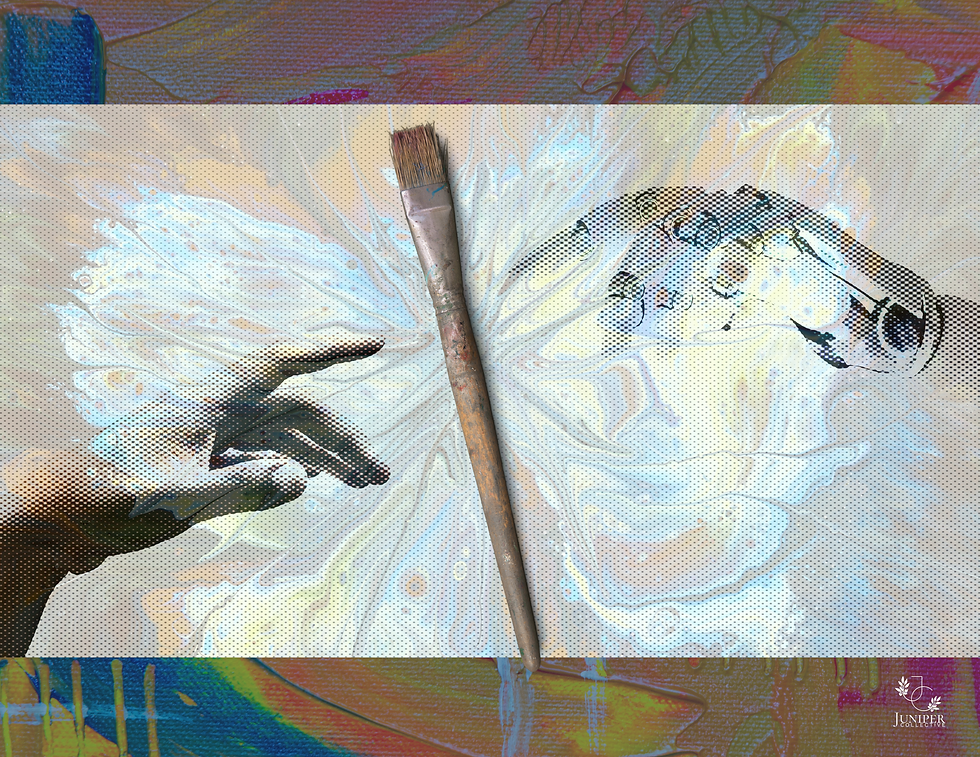
Where experience used to sit
Art has long functioned as a translation device. Something happens, grief, memory, confusion, desire, and it is worked through material. Not resolved, necessarily, but shaped into something that can be held outside the self.
The process matters as much as the result.
A sketch contains hesitation. A rewritten paragraph contains doubt. A performance contains the risk of failure. These are not inefficiencies; they are the record of a mind moving through something it cannot fully control.
AI does not hesitate. It does not risk. It does not need to arrive anywhere because it was never somewhere to begin with.
What it offers instead is a completed surface.
The illusion of interiority
What makes AI art compelling is also what makes it unsettling: it mimics interiority without possessing it.
A generated image of sorrow can look indistinguishable from one grounded in lived experience. A text can echo the cadence of reflection, the structure of thought, even the fragmentation of grief. But these are patterns assembled from prior expressions, not the result of encountering something that resists articulation.
There is no before. There is no after. Only synthesis.
This creates a new kind of encounter. We are no longer responding to an expression of feeling, but to a simulation of what feeling looks like when expressed.
And often, we respond anyway.
What this changes for us
The question is not whether AI art is “real.” It clearly produces real effects. People are moved by it, disturbed by it, drawn into it.
The shift is subtler. It relocates where meaning is generated.
If the artwork is no longer anchored in the experience of a maker, then meaning becomes more dependent on the viewer. The burden of interpretation expands. We supply the body that the work does not have.
This is not entirely new—audiences have always co-created meaning—but the balance changes. The artwork becomes less a transmission and more a surface for projection.
There is a risk here. When everything can convincingly resemble expression, it becomes harder to distinguish between what has been processed and what has merely been produced.
Expression, replaced or reframed
For people who turn to art as a way of working through internal states, this shift matters.
Art, in many contexts, is not about output. It is about the act of making as a way of thinking, or feeling, or surviving. The value lies in the friction—the time it takes, the resistance of the medium, the partial failures along the way.
AI removes much of that friction. It offers immediacy. It can generate multiple versions of a feeling before a person has had time to sit with one.
This can be enabling. It can also be distancing.
There is a difference between expressing something and selecting the closest approximation of it. The difference is not always visible in the result. But it changes what the process does for the person making it.
A rupture: when the body returns
There are works that resist this absence, by using AI under conditions where the body cannot safely appear.
In A Metamorphosis by Lin Htet Aung, the earlier claim begins to fracture. Set to contextualize the violence of Myanmar’s military dictatorship, the film assembles fragments that feel both intimate and unstable: the colors of the national flag, verses from a lullaby, and the disrupted textures of state television. The reported use of an AI-generated voice resembling Aung San Suu Kyi does not register, in this context, as hollow imitation. It carries the weight of something that cannot be spoken directly.
Here, AI does not replace lived experience. It becomes a way of holding it at a distance, enough to be expressed without being exposed.
The body is not absent. It is displaced.
What earlier felt like a limitation begins to look like a condition: when expression is constrained, mediated forms emerge not as shortcuts, but as strategies. The film does not resolve the tension between simulation and expression. It works inside it, using distortion, repetition, and misalignment to refuse the coherence that state narratives depend on.
It is art where the body insists, even when it cannot be seen.
What remains
After this, the earlier claim cannot stay intact.
AI can still produce work that feels detached… patterned, interchangeable, unmoored from experience. But it can also be used in ways that are inseparable from the conditions of making.
The difference is the pressure behind it.
The body, then, does not disappear. It shifts position, into constraint, into risk, into the choices that shape how something is allowed to appear.
AI can reproduce the appearance of a limit. It cannot encounter one on its own.
But it can be used by someone who has.
A quieter question
Instead of asking whether AI can make art, it may be more useful to ask:
What happens to us when we engage with art that was never needed by the one who made it?
What do we lose (or gain) when we begin to outsource not just execution, but the process of working something through?
And when does a tool stop being a substitute, and become one of the few ways something can still be said?
Call
If there’s a film, artwork, or even a generated piece that you think sits in this tension, between expression and simulation, we’re open to looking at it closely. Or if you’re creating something yourself, with or without AI, and it’s trying to hold something difficult, you can send it our way.


Comments