
Why Zines Matter in Mental Health Work

In mental health work, we are used to big things: big frameworks, big reports, big systems that promise to explain, categorize, and fix. But some of the most honest work happens in something small.
Fold a single sheet of paper into eight pages, and you have a zine.
What Zines Make Possible
Zines are DIY, self-published booklets historically used by marginalized communities to express ideas, document experiences, and challenge dominant narratives.
In mental health spaces, they take on a more specific form: madzines.
As Anderson and Spandler (2026), in Mad Zine Pedagogy: Using Zines in Critical Mental Health Learning and Education, explain, madzines are rooted in Mad Studies, a field that challenges mainstream psychiatric and institutional definitions of mental health. Rather than treating lived experience as anecdotal, madzines position it as legitimate, collective knowledge produced by those who have been psychiatrized or marginalized by mental health systems.
Aside from reflecting creativity, they are forms of contention… ways of questioning how mental health is understood, practiced, and governed.
A Different Kind of Knowledge
Much of what we call “mental health knowledge” is filtered and translated into clinical language, standardized formats, and measurable outcomes.
Madzines resist that.
They allow people to express experiences that don’t fit neatly into diagnostic categories or linear recovery stories. As Anderson and Spandler (2026) argue, zines enable the creation and communication of alternative, Mad-centered knowledge grounded in lived experience.
This shifts the question from: “How do we explain mental health?” to: “Whose understanding are we making space for?”
More Than Expression: Process, Critique, Imagination
One of the most powerful contributions of madzines is what they do.
Anderson and Spandler (2026) describe three interconnected functions:
Process: Zines create space to process difficult thoughts and emotions, acting as a holding environment for experiences that may otherwise be hard to articulate.
Active Criticism: They provide creative tools to critique mental health systems, policies, and dominant narratives.
Imagination: They allow individuals and communities to envision alternatives—to care, to recovery, and to the systems themselves.
This is a shift from delivering programs to co-creating spaces where people can process, question, and reimagine.
Why Zines Are Small
Zines are often just one sheet of paper, folded into eight pages.
It reflects a different way of thinking about knowledge, expression, and care. More specifically:
Constraint as permission: An 8-page zine cannot say everything. It resists the pressure to be comprehensive. In a field that often demands completeness, it allows for something partial, unfinished, and real.
Intimacy over scale: Zines are meant to be handed, shared, and passed on. Their size invites closeness.
Accessibility as resistance: Anyone can make a zine. No specialized tools. No gatekeeping. This accessibility has long allowed marginalized voices to speak outside formal systems.
Fragment as truth: Mental health experiences are rarely linear. Zines allow for gaps, contradictions, and unresolved thoughts, mirroring the realities people actually live through.
What This Means for Our Work
As a nonprofit working at the intersection of art and mental health, we see zines as spaces.
Spaces where people can:
Process their own experiences
Share without translating into clinical language
Engage critically with systems that shape their lives
Imagine alternatives that do not yet exist
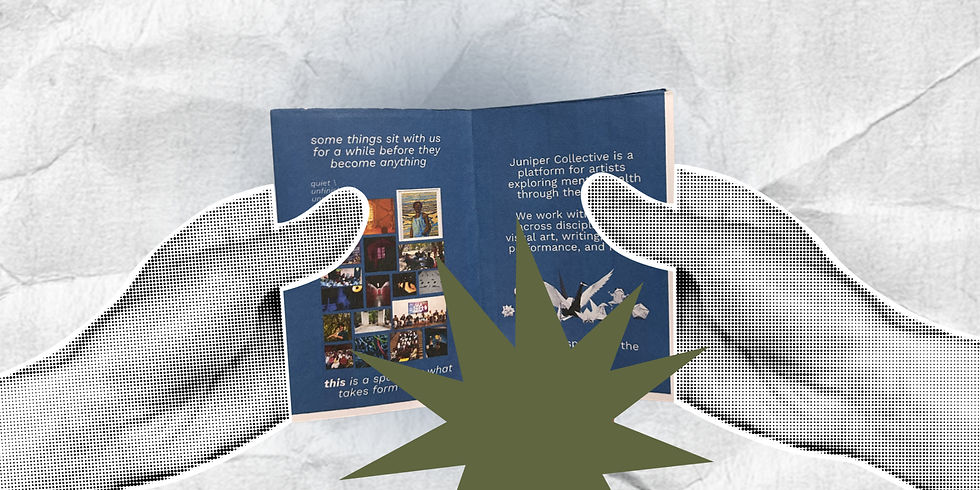
We’ve created our own zine as part of this work.
It holds reflections on mental health, lived experience, and the role of creative expression in making sense of both.
If you would like a copy, you can request one by emailing us. We’ll send you a digital version of the zine.
Sometimes, change doesn’t start with something big. Sometimes, it starts with a folded piece of paper, and the decision to pass it on.
P.S. Do you want to know more about madzines? Read this study for more information: Anderson, J., & Spandler, H. (2026). Mad zine pedagogy: Using zines in critical mental health learning and education. Social Work Education, 45(2), 401-419. https://doi.org/10.1080/02615479.2025.2469586


Comments